“This is a must-read for anyone wanting to understand Jesus and his message more fully—scholars and laypersons alike.”
Jason Staples
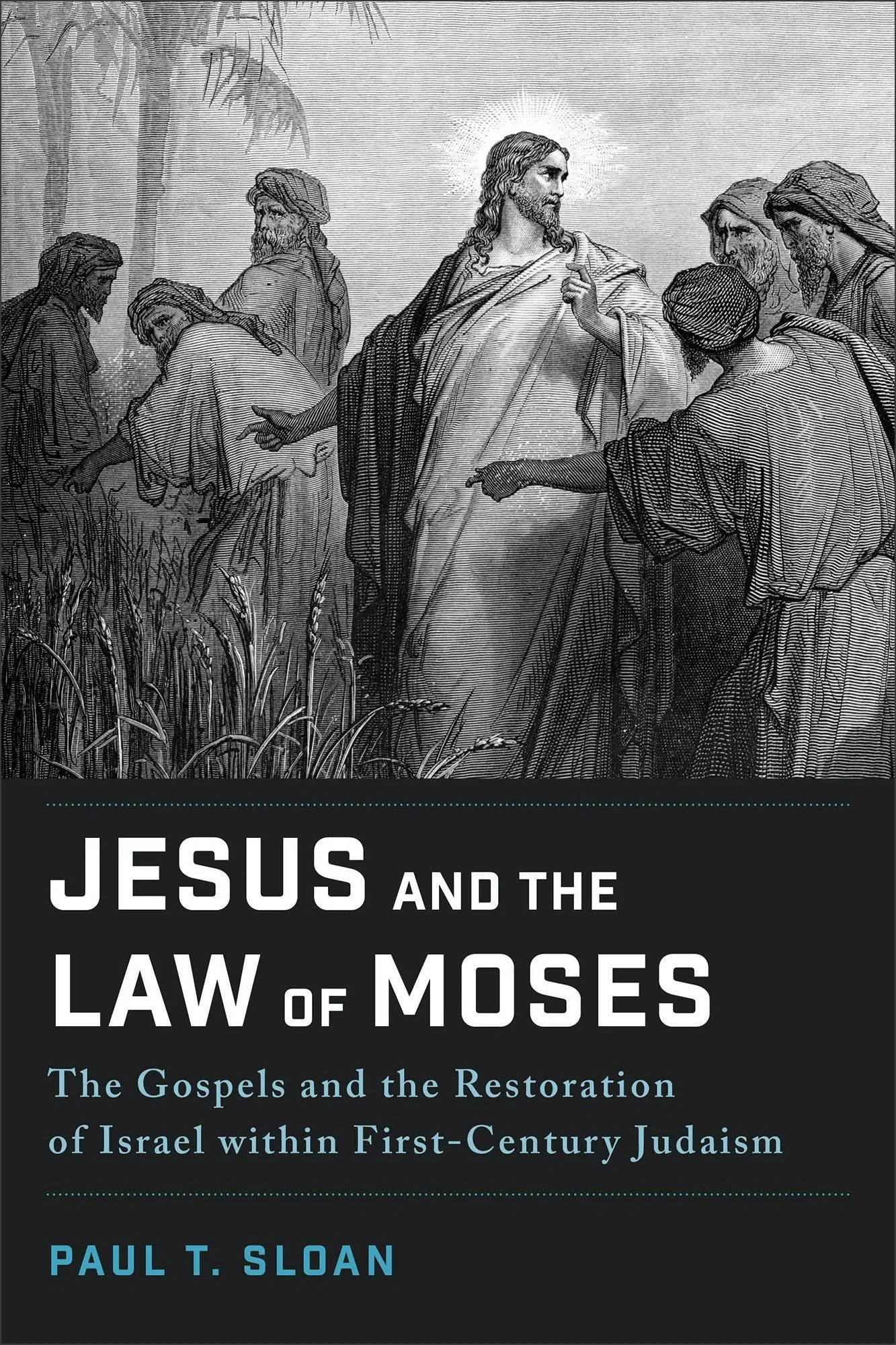
Not long after I finished reading Paul T. Sloan's Jesus and the Law of Moses: The Gospels and the Restoration of Israel within First-Century Judaism (Grand Rapids: Baker Academic, 2025), I sent him a note thanking him for writing it.
I had been eager to read the book. Questions about Jesus and the Jewish Law have occupied my attention for years, and I wanted to see what Sloan would bring to the discussion. I was particularly impressed by his treatment of Matthew 5 and the passages traditionally called the "antitheses." His analysis helped me see familiar texts differently. In fact, some of what I learned has become so much a part of my own understanding that I have to think back to remember where I first encountered those insights.
That's one of the things I appreciate about good scholarship. It doesn't simply give us more information. It changes how we understand what we're reading.
And that's why I wanted to feature Sloan's book in Books in Focus. It makes a substantial contribution to understanding Jesus' relationship to the Law of Moses, challenging familiar Christian assumptions about Jesus and Judaism. It is a book I think more people should know about.
Sloan's central argument is that Jesus' teaching about Torah must be understood in relation to his mission to restore Israel. That perspective changes how we read some of the most familiar—and frequently misunderstood—passages in the Gospels.
The Law and the Restoration of Israel
Sloan's argument begins with Israel's Scriptures, particularly their promises of restoration. Israel's covenant with God entailed obligations as well as blessings. The prophets understood Israel's suffering and subjection to foreign powers in relation to covenantal unfaithfulness. Yet they also anticipated God's mercy: Israel would be gathered, renewed, and enabled to obey God's commandments faithfully.
Within this story, Jesus announces that Israel's promised restoration is arriving. He calls people to repentance, gathers disciples, and teaches them how to live as the people God is restoring. His relationship to Torah is therefore not incidental to his mission. Teaching Israel to keep the Law is part of the work of restoration.
This changes the way we hear the Gospel controversies. Jesus and other Jewish teachers argue about what the commandments mean and what observance requires. Their disagreements are not evidence that Jesus has abandoned Judaism. They are recognizably Jewish disagreements about fidelity to God's Law.
Sloan makes this point repeatedly and with close attention to biblical texts and ancient Jewish interpretation. That alone makes the book an important contribution, particularly for Christian readers accustomed to contrasting Jesus' graciousness with a supposedly rigid Judaism.
Hearing Matthew 5 Differently
I especially appreciated Sloan's treatment of Matthew 5. The familiar phrase the antitheses refers to the passages where Jesus says, "You have heard that it was said ... but I say to you." The label makes Jesus sound as though he is setting his own teaching against Moses.
But earlier in the chapter Jesus insists that he has not come to abolish the Law and warns against relaxing even its least commandments. Sloan asks us to take that claim seriously as we read what follows.
Consider Jesus' teaching about adultery. Jesus says that looking at a woman with covetous desire belongs to the moral world of adultery. We often hear this as Jesus moving beyond external Jewish rules to an inward Christian ethic. Yet the Torah itself already prohibits coveting another man's wife. Jesus is interpreting one commandment through another.
That observation may seem simple, but it changes the reading. Jesus is not replacing Moses with something better. He is reasoning from within Torah about the conduct and desires of those who belong to Israel.
I found Sloan's treatment of these passages particularly illuminating. Some of his insights have become part of how I now understand and teach Jesus' words. That is one of the pleasures of reading good scholarship: you find yourself seeing a familiar text differently, and eventually you can hardly remember having seen it any other way.
The Demands of an Arriving Kingdom
Sloan also proposes a concept he calls eschatological nomism: the observance of Torah in the circumstances created by the arrival of God's promised restoration. Nomism concerns the Law and its practice; eschatological points to God's long-awaited intervention in Israel's history.
The idea helps him distinguish ordinary legal disagreements from episodes in which Jesus' mission itself becomes central. In some controversies, Sloan argues, the demands of that mission explain why an otherwise binding obligation does not apply in the usual way.
This is the part of the book that left me with a question. Does Jesus' eschatological mission itself establish the legal grounds for such an exception, or does Jesus' teaching make better sense as the interpretation of Torah through Torah, including the prophetic insistence on justice, mercy, and faithfulness? I am still thinking about that question.
It does not diminish my appreciation for what Sloan has accomplished. Indeed, it is a measure of the book's value that it has made me examine more carefully both the Gospel passages and the kinds of Jewish legal reasoning that might illuminate them.
Why This Book Matters
Jesus and the Law of Moses won the 2025 Christianity Today Book Award for Biblical Studies, and it deserves the attention it has received. Sloan provides a coherent account of Jesus as the herald of Israel's restoration and an authoritative Jewish interpreter of the Law. He also carries that account forward into the Temple, Jesus' death, and the earliest Jesus movement.
The book requires close reading, but its central argument matters well beyond scholarly debates. Pastors, students, and thoughtful readers will find it especially valuable if they have been taught that Jesus' conflicts with the Pharisees were conflicts between Christianity and Judaism, or between grace and obedience.
At the Schubach Library, we want readers to encounter books that help them see the New Testament within its Jewish world. Sloan's book does precisely that. Even if you never read it cover to cover, its central proposal is worth considering: What if Jesus' disputes about the Law were not evidence that he stood outside Judaism, but evidence that he was teaching Israel how to live faithfully within it?