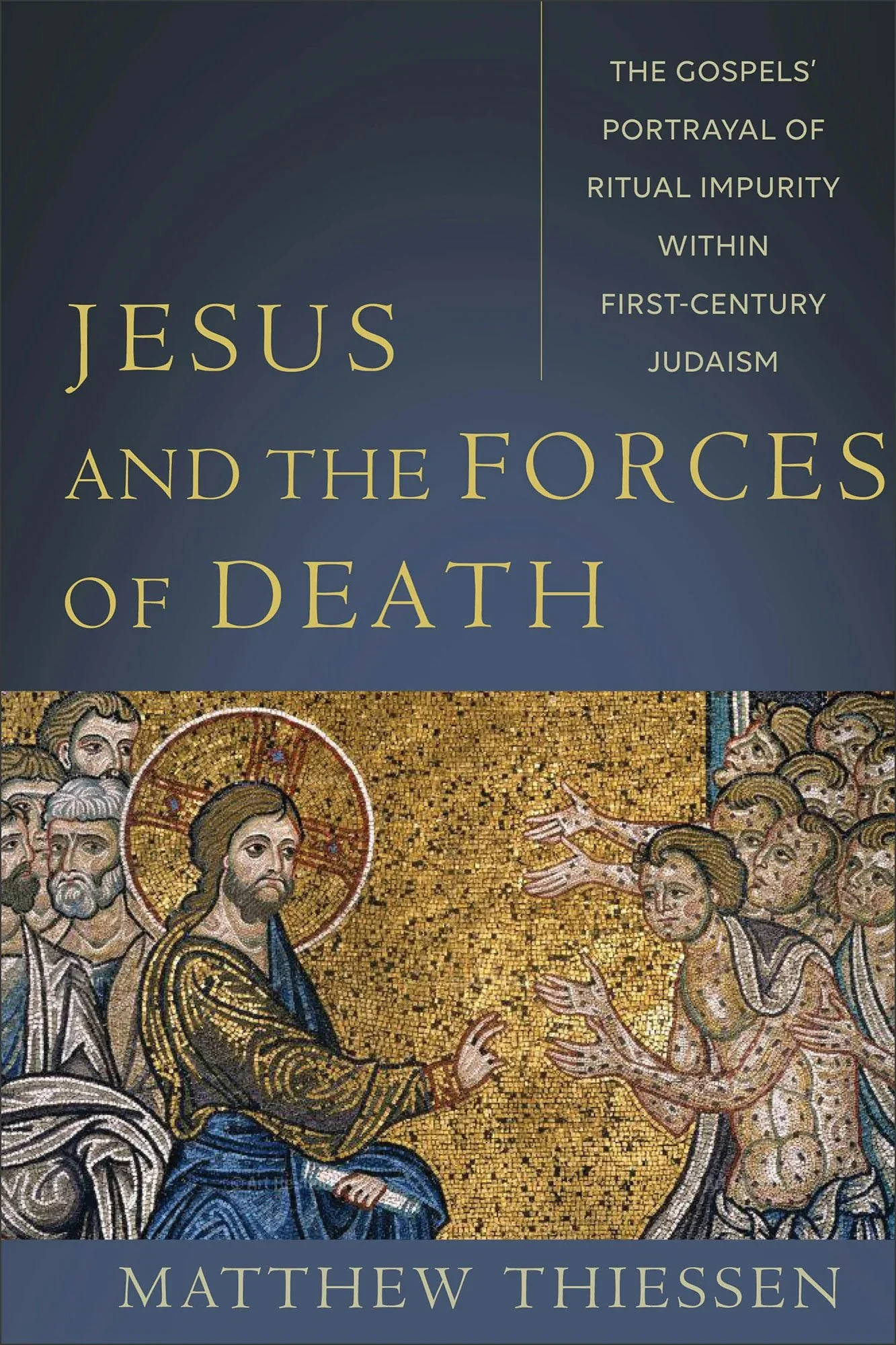
Jesus the Purifier: Introducing Matthew Thiessen’s Jesus and the Forces of Death
“This book would be an excellent addition to any course in New Testament and would be extremely helpful to preachers who encounter any of the multiple passages that deal with Jesus’s healing narratives and disagreements with the Pharisees. Much anti-Jewish harm can be undone, while a fresh new portrait of Jesus emerges. The readable style will be welcome to lay groups that want to study a provocative book that shows Jesus’s powers in a new light.”
Marianne Blickenstaff | Belmont University Nashville, Tennessee
There is a major theme running through the Synoptic Gospels—Matthew, Mark, and Luke—that is often ignored, misunderstood, or treated as evidence that Jesus dismissed Jewish law.
Again and again Jesus encounters uncleanness. He cleanses people with skin disease. He heals a woman whose flow of blood makes her ritually impure. He touches the dead and restores them to life. He confronts “unclean spirits” and frees people from their power.
What are we supposed to make of all this?
If these stories have ever raised questions for you, Matthew Thiessen’s Jesus and the Forces of Death is a book worth reading. It helped me better understand the Jewish world of Jesus and, in doing so, gave me a greater appreciation for what the Gospel writers are claiming about Jesus himself.
Thiessen begins where most of us need to begin: with the Jewish categories of clean and unclean, pure and impure.
Learning the World of Clean and Unclean
For many modern readers, “unclean” sounds like another word for sinful. But that is not how ritual impurity works in the Torah.
A person could become impure through ordinary features of embodied life. Bodily discharges produced impurity. Certain skin conditions produced impurity. Contact with a corpse produced impurity. None of these conditions necessarily resulted from wrongdoing.
Impurity also was not permanent. The Torah provided ways of dealing with it. Depending upon its source, purification might involve washing, waiting for a prescribed period, priestly examination, or sacrifice.
These distinctions matter because they belonged to the Jewish world in which Jesus lived. Yet Christian readers often approach the Gospel stories without them. As a result, when Jesus encounters someone who is unclean, we can easily assume that the point of the story is that Jesus ignores or overturns Jewish purity laws.
Thiessen asks us to look again.
Jesus is not portrayed as opposing the Torah’s distinction between purity and impurity. He is opposing the things that produce impurity.
That difference changes how these stories look.
A Broad-Scale Purification Mission
Thiessen describes Jesus as engaged in a “broadscale purification mission.”
In one group of stories, Jesus confronts what we might call the this-worldly sources of ritual impurity. Bodies bleed. Skin deteriorates. People die. These are features of mortal human existence, and the Torah provides ways for Israel to live faithfully in a world in which such impurity exists.
But Jesus does something striking. He does not merely manage impurity. He eliminates its source.
The bleeding stops. Diseased bodies become whole. Corpses return to life.
Normally, we might expect uncleanness to pass from the impure person to the person who comes into contact with them. In these Gospel stories, the direction seems reversed. Jesus comes into contact with impurity, and impurity gives way.
But the Synoptic Gospels also present another kind of uncleanness.
They repeatedly describe demons as “unclean spirits.” Here the problem is not simply the impurity associated with ordinary mortal existence. There is an apocalyptic dimension to the Gospel world as well. Hostile spiritual forces afflict and enslave human beings.
Jesus confronts these sources of uncleanness too.
The unclean spirits recognize him. They fear him. And he drives them out, freeing those whom they have tormented.
This makes the Gospel description of Jesus as the “Holy One of God” especially significant. The Synoptic writers portray Israel’s God as unleashing into the world a force of holiness that goes on the offensive against impurity. Jesus destroys its sources, whether they appear in diseased and dying bodies or in the power of unclean spirits. He then sends his disciples out to continue this work in his name.
Holiness has become mobile.
Impurity and the Forces of Death
Thiessen’s larger argument helped me see a connection I had not sufficiently appreciated: impurity in these stories is closely connected with death.
The connection is obvious with a corpse, but it extends beyond death itself. Bleeding, bodily deterioration, disease, and mortality all belong to a world in which human life moves toward death. The demonic realm, too, belongs to the Gospel writers’ larger picture of hostile powers from which Israel’s God is delivering his people.
Jesus’ purification mission therefore reveals something larger about his significance.
Israel’s God is battling the forces of death.
The healings, cleansings, exorcisms, and raisings of the dead are not simply a collection of remarkable acts of compassion. Together they tell a story about what the Gospel writers believe God is doing through Jesus. The kingdom of God means that holiness and life are invading a world marked by impurity and death.
That helped me see familiar Gospel stories with fresh eyes.
Why This Book Matters
Jesus and the Forces of Death is an excellent example of why reading Jesus within his ancient Jewish context matters.
Without understanding the Torah’s categories of clean and unclean, purity and impurity, we can easily mistake what Jesus is doing. We may even turn stories rooted deeply in Jewish ways of understanding holiness into evidence that Jesus was rejecting Judaism.
Thiessen shows another possibility. The Jewish purity system is not the obstacle Jesus must overcome. It supplies the world of meaning within which the Gospel writers explain his mission.
And once that world becomes visible, something else becomes visible too.
The Synoptic Gospels present Jesus as the Holy One of God through whom Israel’s God confronts impurity at its sources. Bodies are restored. Unclean spirits are expelled. The dead are raised. And Jesus’ followers are commissioned to extend that work.
Thiessen helped me understand the Jewish world of Jesus more clearly. But more than that, he helped me see more clearly what the Gospel writers want us to understand about Jesus within that world.
That is why this is a book I wanted to bring to your attention.