Did Jesus Correct the Disciples’ Hope for Israel?
Part Seven of “Does Jesus’ Jewishness Matter More Than We Realize?”
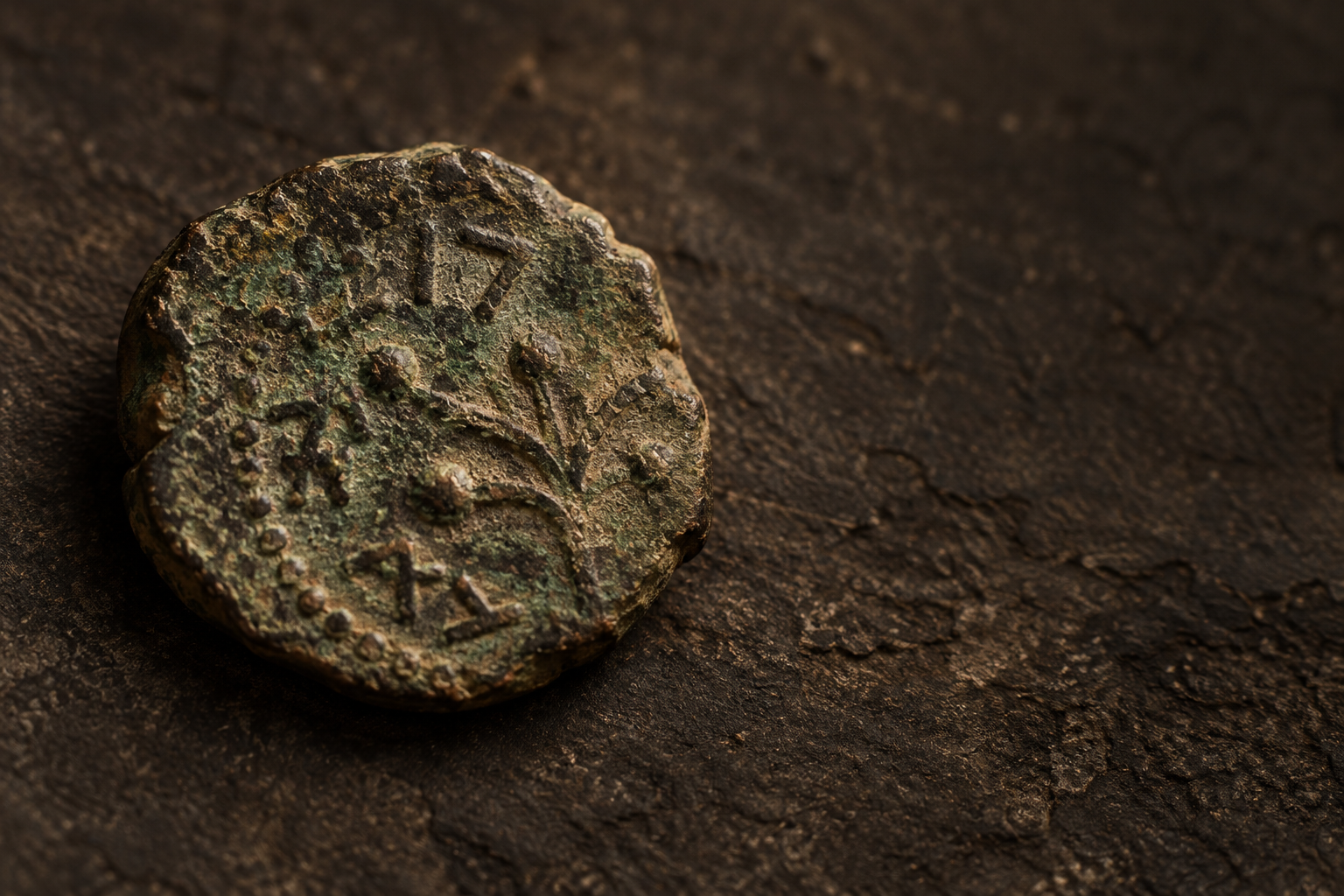
Bronze Hasmonean coin of John Hyrcanus I, minted in Jerusalem, 130–104 BCE
Acts 1:1–8
Did the disciples . . .
. . . get it wrong again?
The risen Jesus has spent forty days teaching them about the kingdom of God. Just before his ascension, they ask:
Lord, is this the time when you will restore the kingdom to Israel?
Many Christians hear this as one final misunderstanding. The disciples still expect Israel’s national restoration—a renewed Davidic kingdom connected to a particular people and land. Jesus redirects them toward something larger and more spiritual: the Holy Spirit will empower the church to carry God’s reign throughout the world.
Israel’s kingdom gives way to the church’s mission.
More careful versions of this interpretation do not say that Israel is simply discarded. They say that Israel’s hope is transformed. The restored kingdom now takes the form of a worldwide people gathered around Jesus. Its king reigns from heaven, and its borders extend to the ends of the earth.
But is that what Jesus actually says?
The hope Luke has given us
The disciples do not suddenly invent the hope of Israel’s restoration.
Luke has filled his Gospel with it. Gabriel announces that Jesus will receive “the throne of his ancestor David” and reign over “the house of Jacob.” Mary celebrates the God who has helped Israel in remembrance of the promises made to Abraham. Zechariah declares that God has “looked favorably on his people and redeemed them.”
Simeon waits for “the consolation of Israel.” Anna speaks to those awaiting “the redemption of Jerusalem.”
These hopes concern a particular people, a royal house, and a city. Luke does not begin with an abstract idea of God reigning everywhere. He begins with Israel waiting for its God to fulfill promises.
Even after Jesus’ death, the disciples on the road to Emmaus say:
We had hoped that he was the one to redeem Israel.
Jesus corrects their failure to understand that the Messiah had to suffer. But he never tells them that hoping for Israel’s redemption was itself the mistake.
Now Jesus has risen from the dead. If he really is Israel’s Messiah, the disciples’ question seems natural: Is this the time when the promised restoration will happen?
Listen to Jesus’ answer
Jesus replies:
It is not for you to know the times or periods that the Father has set by his own authority.
Notice what he does not say.
He does not say that the kingdom will not be restored. He does not say that God is finished with Israel. He does not replace Israel with the church.
The disciples ask whether the restoration will happen at this time. Jesus tells them that the time belongs to the Father.
He then gives them their task:
You will receive power when the Holy Spirit has come upon you, and you will be my witnesses in Jerusalem, in all Judea and Samaria, and to the ends of the earth.
We often hear this as a contrast between two different hopes: not Israel, but the world; not a Jewish kingdom, but a universal church.
Israel’s Scriptures do not require that choice. The Prophets expected Israel’s restoration to bring blessing to the nations. God would redeem Israel, renew David’s rule, and extend the knowledge of Israel’s God to the ends of the earth.
The mission begins in Jerusalem, moves through Judea and Samaria, and then reaches the nations. The story moves outward from Israel. It does not move away from Israel.
Jesus may be telling the disciples what they must do while they wait, not redefining what they are waiting for.
What happens next?
The events that follow make the question even more interesting.
Judas has left the apostolic group, reducing its number to eleven. Before Pentecost, the disciples choose Matthias to restore the number twelve.
Why does twelve matter?
The twelve apostles symbolize the twelve tribes of Israel. Jesus had promised that they would sit on thrones judging the twelve tribes. Replacing Judas is therefore more than filling a vacant position. It symbolizes Israel being gathered and renewed around its Messiah.
Then the Spirit comes at Pentecost. Peter explains what has happened through the prophet Joel. The Spirit promised in Israel’s Scriptures has begun to be poured out. The first recipients are Jews gathered in Jerusalem from across the nations.
They continue meeting at the Temple. Peter addresses them as “the people of Israel.” In Acts 3, he still speaks of coming “times of restoration” announced by the prophets.
Luke will soon tell us how Samaritans and Gentiles are welcomed. The message will eventually reach Rome. But the nations enter a story that remains Israel’s story. They encounter Israel’s God through Israel’s Messiah and the Jewish witnesses he sends from Jerusalem.
What are we assuming?
Acts 1 does not tell us exactly what the completed restoration of Israel will look like. It does not provide a simple map for modern politics. Jesus does transform expectations about how God’s kingdom comes. Israel’s Messiah reigns after crucifixion and resurrection, and his witnesses receive the Spirit rather than weapons.
But has Jesus transformed Israel’s restoration into something that no longer belongs particularly to Israel?
The text never says so.
The disciples ask whether Jesus will now restore the kingdom to Israel. Jesus tells them that its timing belongs to the Father and that they have work to do.
Perhaps we have turned an answer about timing and vocation into a rejection of the disciples’ hope.
Why Jesus’ Jewishness matters
Jesus’ Jewishness matters after Easter because the risen Jesus remains Israel’s Messiah.
His resurrection does not detach him from the promises made to Israel. His mission to the nations does not require Israel to disappear. The story can expand without abandoning the people, places, and promises from which it began.
When Christians treat the disciples’ question as their final Jewish misunderstanding, Israel becomes temporary scaffolding. It supports the story until the church appears and then is taken away.
But what if the disciples are not wrong to expect Israel’s restoration?
What if Jesus corrects their timetable, gives them the Spirit, and sends them to bear witness while they wait?
In the final Dispatch, we will follow Jesus’ earliest followers after Pentecost. Did receiving the Spirit lead them away from Jewish life, or did they continue to worship, pray, and live as Jews?