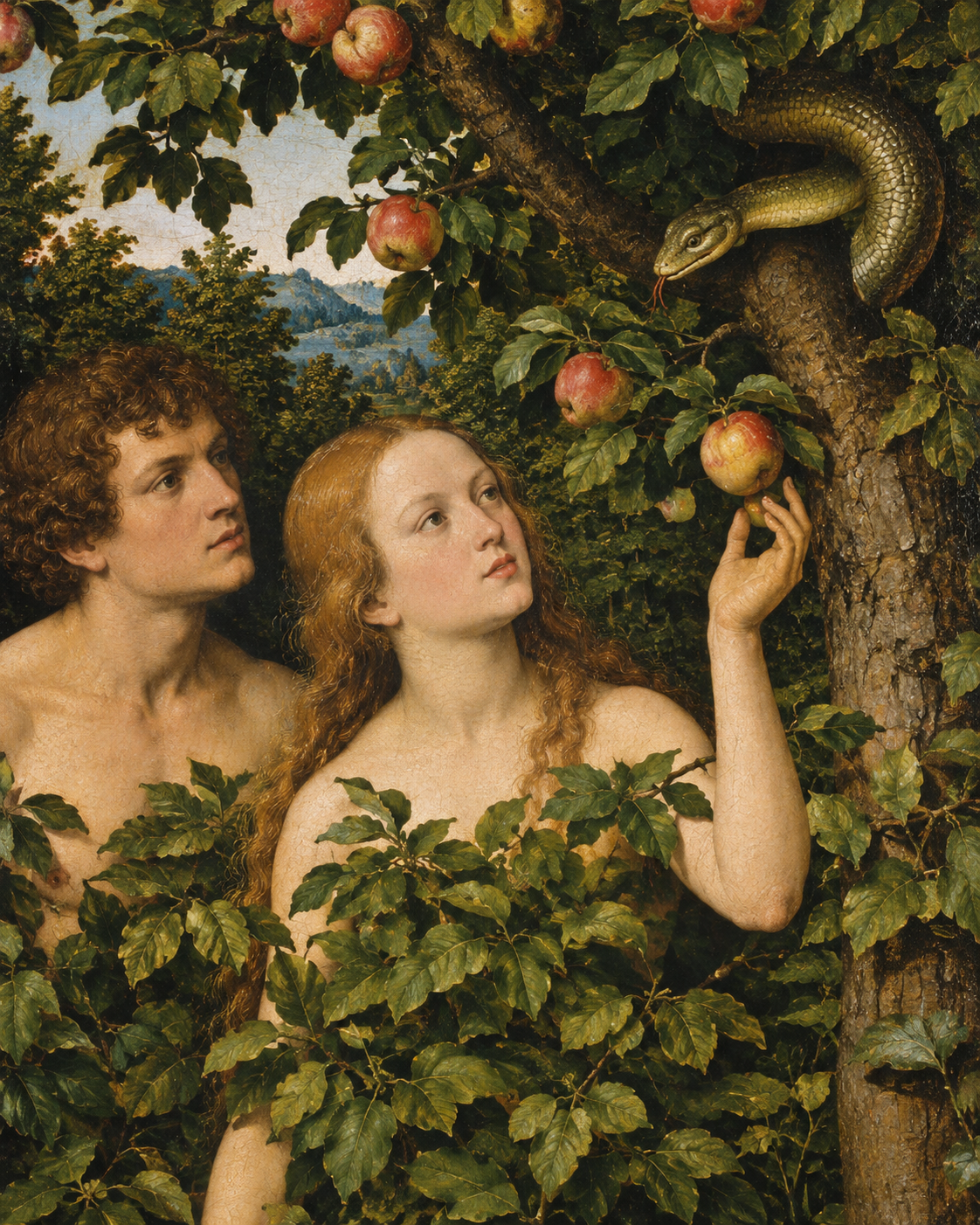
Adam and Eve at the tree. Original AI-generated illustration in the style of Northern Renaissance painting.
What If Adam and Eve Were Fifteen? — Part 3
What did the woman see when she looked at the tree?
Genesis tells us:
“The woman saw that the tree was good for food, that it was a delight to the eyes, and that the tree was desirable for gaining wisdom. So she took some of its fruit and ate. She also gave some to her husband, who was with her, and he ate” (Genesis 3:6, my translation).
I have read this passage for most of my life as the moment when everything went terribly wrong. Adam and Eve disobeyed God, and their disobedience brought devastating consequences. That much is unmistakable.
But I have begun to wonder whether I have understood what makes this moment so terrible.
For centuries, Western Christians have read Genesis 3 through an interpretation profoundly shaped by Augustine. He understood the first disobedience as an extraordinarily grave sin, rooted in pride and the desire to turn away from God.¹ We have inherited a picture of mature human beings who understood what they were doing and nevertheless chose to rebel against their Creator.
But is that how the narrator characterizes them?
Naked Humans and a Crafty Serpent
Before the woman looks at the tree, the narrator has prepared us for the encounter with a remarkable play on words.
Genesis 2 ends by describing the man and woman as naked (ʿărummîm) and unashamed (2:25). Genesis 3 begins by describing the serpent as crafty (ʿārûm) (3:1). The similarity in Hebrew is unmistakable.
The word translated “crafty” deserves attention. Elsewhere in the Hebrew Bible, particularly in Proverbs, it frequently describes someone who possesses practical intelligence: a person who recognizes danger, anticipates consequences, and knows how to act. Such intelligence can be admirable. Proverbs 22:3, for example, describes the prudent person as someone who sees danger and takes precautions.
But the same capacity can be employed for harmful purposes. In Job 5:12–13, the crafty devise schemes that God frustrates.
The narrator tells us that the serpent possesses this quality more than any other animal God had made. Before the serpent speaks a single word, we know something important about its character. It possesses an exceptional capacity for shrewdness.
The contrast with the humans is striking. They are naked and unashamed. The serpent is exceptionally shrewd.
The narrator has not described the humans as foolish or incapable of judgment. The man has named the animals, recognized the woman as his corresponding partner, and received God's instructions. These are substantial capacities. But the narrator has not attributed to either human the kind of strategic intelligence that distinguishes the serpent.
And then the serpent begins to speak.
The Conversation That Changed Everything
The serpent approaches the woman and challenges God's instruction. He begins with a question that misrepresents the prohibition: “Did God really say, ‘You shall not eat from any tree in the garden’?” (3:1).
The woman corrects him. They may eat from the trees of the garden, but God has prohibited eating from the tree in the middle of the garden. She also says they must not touch it, or they will die.
The serpent directly contradicts the warning: “You will not die” (3:4).
He then offers an explanation. God knows that when they eat, their eyes will be opened, and they will become like God, knowing good and evil (3:5).
Notice what has happened. The serpent has challenged God's words and supplied an alternative explanation for God's intentions. According to the serpent, the prohibition stands between the humans and something desirable.
The narrator has already told us that the serpent is exceptionally shrewd. Now we watch that shrewdness at work.
The serpent does not force the woman to eat. He persuades her. He offers a way of understanding the tree that makes eating from it appear attractive.
We should appreciate the disparity between the participants in this encounter. The serpent is characterized by an exceptional capacity for strategic intelligence. The humans have demonstrated intelligence, competence, and the ability to understand instructions, but the narrator has given us no comparable indication that they possess experience recognizing deception.
That distinction is central to the question I've been asking throughout this series.
What if Adam and Eve were more like fifteen-year-olds than twenty-five-year-olds?
I am speaking about maturity rather than chronological age. A fifteen-year-old can understand a prohibition, make a consequential decision, and bear responsibility for that decision. But understanding a rule is different from possessing the experience and judgment necessary to recognize when someone is manipulating you.
The serpent's words exploit precisely the kind of vulnerability that inexperience can create.
What the Woman Saw
Now we are ready to return to Genesis 3:6.
The narrator gives us three reasons the tree attracted the woman. It was good for food, pleasing to the eyes, and desirable for gaining wisdom.
Each deserves attention.
First, the tree was good for food. Eating is fundamental to human existence. God had placed the humans in a garden filled with trees that were both beautiful and good for food (2:9). The woman's perception therefore echoes the narrator's earlier description of God's provision.
Second, the tree was pleasing to the eyes. The woman saw something beautiful. Again, this is hardly surprising. God created humans with eyes capable of appreciating the world around them. The beauty of the trees was already part of the garden's goodness.
Third, the tree was desirable for gaining wisdom. Here we encounter something especially interesting. The woman wanted to become wise.
What should we make of that desire?
Wisdom is hardly a vice in the biblical imagination. It is something to be sought, cultivated, and cherished. The desire to understand the world, to distinguish good from evil, and to exercise sound judgment belongs to human flourishing.
The problem, of course, is that God had prohibited eating from this particular tree. The woman's desires brought her toward something she had been told not to take.
But notice what the narrator actually says about her motivations. She sees food, beauty, and the possibility of wisdom. The narrator does not tell us that she despised God, resented her creaturely condition, or intended to overthrow divine authority.
Those are interpretations of her action. They are not the motivations the narrator attributes to her.
And we must remember that her perception follows the serpent's conversation. The woman is looking at the tree after someone has challenged God's warning and presented eating as the means to acquire something desirable.
The narrator has arranged the sequence carefully. First, he characterizes the serpent. Then he shows us the serpent's words. Only afterward does he describe what the woman sees.
Her decision belongs within that sequence.
She Took and Ate
The narrator describes the woman's action with remarkable economy. She took the fruit and ate. Then she gave some to her husband, who was with her, and he ate.
The phrase “with her” deserves attention. The narrator does not describe the man arriving after the conversation. The natural impression is that he is present, although the narrative does not specify precisely when he joined her.
He says nothing.
We have spent centuries asking why the woman listened to the serpent. We should also ask what the man understood, what he heard, and why he participated. Genesis leaves much of that unexplained.
What it does tell us is that both humans ate.
They crossed a boundary God had established. Their participation was real. Nothing about their inexperience makes the action disappear.
But responsibility for an action and responsibility for the circumstances in which that action occurs are different questions.
The narrator has shown us a serpent who possesses exceptional shrewdness, a conversation in which he manipulates God's words, and a woman who acts after hearing his alternative explanation.
When God later asks what happened, the woman says, “The serpent deceived me, and I ate” (3:13).
Her explanation acknowledges both the deception and her action.
We should not overlook either.
Their Eyes Were Opened
What happened after they ate?
“Then the eyes of both were opened, and they knew that they were naked. And they sewed fig leaves together and made coverings for themselves” (3:7).
The serpent had promised that their eyes would be opened. And they were.
But what did they see?
The narrator does not describe a sudden realization of their extraordinary wickedness. Nor does he tell us that they became conscious of an overwhelming offense against God.
They became aware of their nakedness.
This is especially striking because Genesis 2 ends by telling us that the man and woman were both naked and were not ashamed (2:25).
Nothing about their bodies has changed. Yet their experience of their bodies has changed dramatically.
Before the encounter, they could stand naked before one another without shame. Afterward, they cover themselves.
Something has happened to their understanding of themselves.
I find this deeply moving. The first consequence the narrator describes is an alteration in the humans' experience of their own bodies. They see themselves differently. Their former ease with one another has disappeared.
Genesis does not explain everything that nakedness means in these verses. But the contrast between 2:25 and 3:7 is deliberate. Something precious has been lost.
And it cannot simply be recovered by wishing the encounter had never happened.
The humans have acquired knowledge. God himself will later acknowledge that they have become like divine beings in knowing good and evil (3:22). Yet their first experience of that knowledge is troubling. They cover themselves, and when God approaches, they hide.
Knowledge has arrived together with fear and shame.
What Was Done to Them
As I have been reading this story, I have found myself thinking about people whose lives have been shaped by exploitation and abuse.
A person may make choices that have terrible consequences without adequately understanding the circumstances in which those choices are being made. Someone else may have manipulated their understanding, exploited their inexperience, or taken advantage of their trust.
And the consequences may remain long after the encounter has ended.
This is one reason I find the experience of childhood sexual abuse such a disturbing analogy for Genesis 3. A predator can exploit a child's trust, curiosity, bodily experience, and desire for affection or understanding. A child may participate in what happens without possessing the knowledge necessary to recognize the exploitation. That participation does not make the child responsible for the abuse.
The consequences can profoundly affect how a person experiences their own body, their relationships, and themselves.
Genesis 3 is not a story about sexual abuse. But the narrator's portrayal of a crafty deceiver manipulating inexperienced humans has made me attentive to something I once failed to recognize.
The humans' wrongdoing does not erase what was done to them.
This is a distinction I have rarely encountered in traditional interpretations of Genesis 3. We have devoted extraordinary attention to the humans' disobedience. But what about the serpent's deception? What about the humans' vulnerability? What about the terrible changes in their experience of themselves?
What if these are central to the tragedy the narrator is telling us?
The Magnitude of the Tragedy
Augustine understood the extraordinary consequences of this event in relation to the extraordinary gravity of the humans' sin. Their disobedience was a profound moral catastrophe.
I am beginning to read the narrative differently.
Consider what the narrator has shown us.
Good creatures inhabit a world God has provided for them. They possess ordinary human desires for food, beauty, and wisdom. They encounter a being distinguished by exceptional shrewdness. He manipulates their understanding of God's words and intentions. They act, and their actions have consequences.
Then their eyes are opened.
They become ashamed of their nakedness. They cover themselves. Soon they will be hiding in fear.
Their lives have changed in ways they could not have anticipated.
I do not need to imagine them innocent to recognize the enormity of what has happened. They are responsible for eating. But their responsibility does not erase the serpent's deception, their vulnerability, or the terrible consequences they now experience.
I wonder what centuries of reading Genesis 3 primarily as a story about the magnitude of human wickedness have done to Western Christian understandings of humanity. What have we learned to see in the first humans? And what have we failed to see?
The narrator has given us a serpent distinguished by exceptional shrewdness, humans susceptible to deception, and consequences they could scarcely have anticipated.
Their disobedience is unmistakable. But the magnitude of the tragedy cannot be measured by the magnitude of their disobedience.
Something terrible happened to these humans.
Their responsibility for what they did does not erase what was done to them.
Note
Augustine, The City of God 14.11–15, especially 14.13, on pride, the first disobedience, and its consequences.