Beyond the New Testament Series
Why look beyond the New Testament to understand the New Testament? Read the introduction to this series.
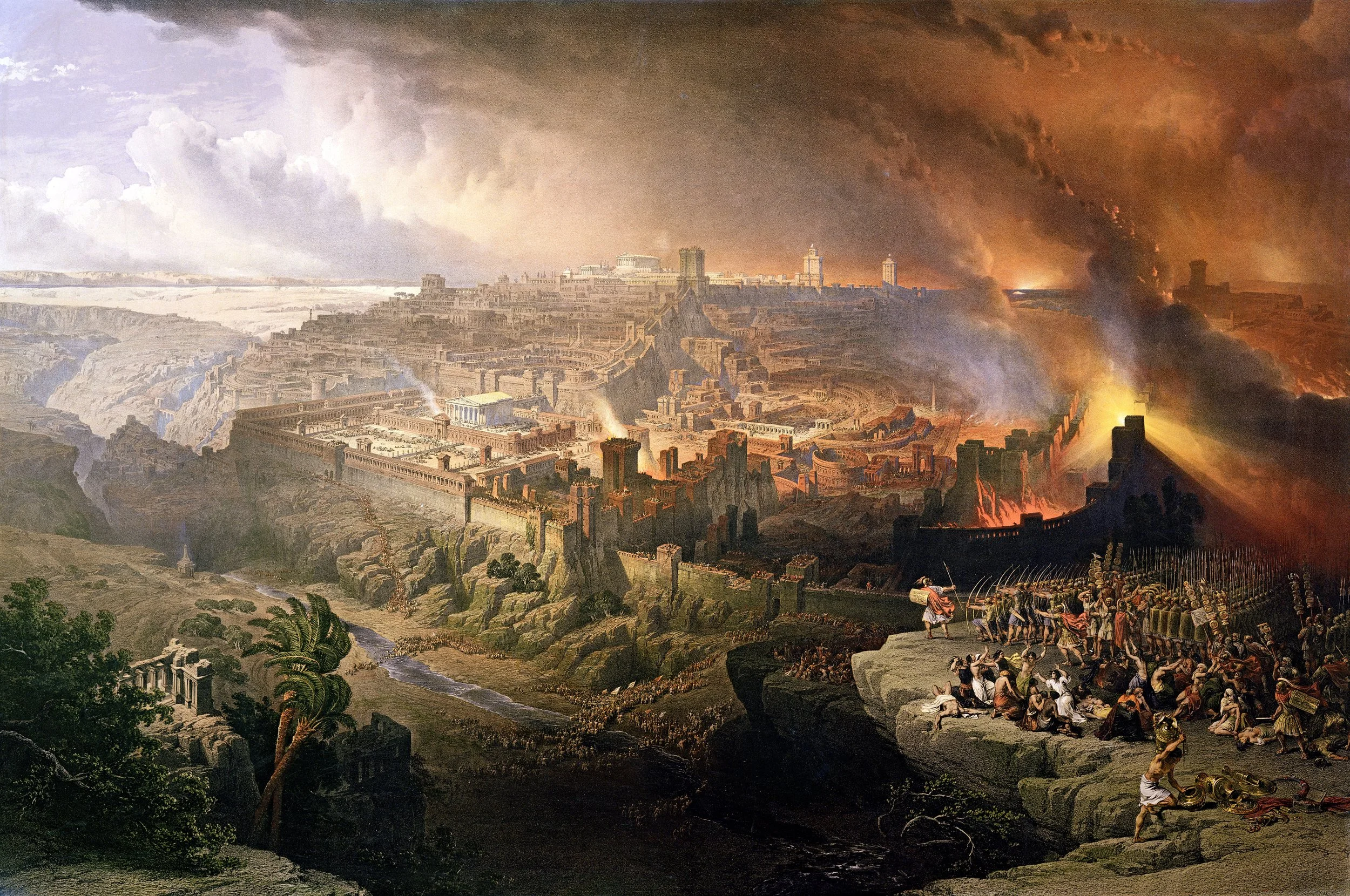
In 70 CE, Roman armies destroyed Jerusalem and burned the Temple. For Jews who understood themselves as God’s covenant people, the catastrophe raised more than political questions. Had God abandoned Israel? Had the covenant failed? How should Israel live when the center of its worship had disappeared?
One Jewish writer answered those questions by retelling an earlier destruction.
The book we call 2 Baruch presents itself as the words of Baruch, the scribe of Jeremiah, after Babylon destroyed Jerusalem in 586 BCE. But the book was written much later, in the aftermath of Rome’s destruction of the city in 70 CE. The author uses the earlier catastrophe to speak to Jews living through the later one.
A Revelation after Catastrophe
2 Baruch is an apocalypse. Today, the word often brings to mind disaster, violence, or the end of the world. In ancient Jewish literature, however, an apocalypse is a revelation. It draws back the curtain on history and shows what cannot be seen from the surface of events.
Jerusalem lies in ruins. Rome appears to have won. The righteous suffer alongside the wicked. Yet the visions of 2 Baruch reveal that the present age remains under God’s control. Evil has a limit. Judgment is coming. The dead will rise. Another world lies beyond this one.
The book does not deny the catastrophe. It places it within a larger story.
That is what apocalypse does in 2 Baruch. It reveals that history means more than present circumstances appear to show.
The Torah Still Matters
What makes the book especially interesting is that its apocalyptic visions do not replace Israel’s covenantal life.
Again and again, Baruch calls the people to remember the Torah, keep the commandments, observe the Sabbaths and festivals, and teach the law to the next generation. The Temple has fallen, but the covenant has not disappeared. Israel must still live as Israel.
This reflects the pattern of Deuteronomy, where Israel is repeatedly called to choose faithfulness and life. Obedience matters. Repentance matters. Human beings remain responsible for how they live.
That framework might seem difficult to hold together with apocalypse. If God must intervene to judge evil, raise the dead, and bring another age, what can Torah observance accomplish?
2 Baruch does not answer by making obedience irrelevant. It also does not imagine that obedience alone will repair history. Keeping the commandments will not rebuild the Temple, overthrow Rome, raise the dead, or bring the present age to its end. Those things require God’s action.
Torah and apocalypse therefore do different work.
Torah tells Israel how to live after catastrophe. Apocalypse reveals why that faithfulness is not futile.
Faithfulness While Waiting
This joining of commandment keeping and apocalyptic hope also appears in Revelation.
Revelation is another Jewish text from the world of the early Roman Empire. Its visions portray beasts, empire, judgment, resurrection, and the arrival of God’s reign. Yet when John describes the faithful, he identifies them as those who “keep the commandments of God and hold fast to the faith of Jesus” (Rev. 14:12).
The vision of what God will do does not make obedience unnecessary. It gives the community a reason to endure.
Revelation and 2 Baruch respond to different circumstances and do not say everything in the same way. Yet both texts join a vision of God’s coming intervention with a demand for faithfulness in the present. Neither treats apocalypse as an escape from covenant responsibility.
God’s people remain faithful while they wait for God to set the world right.
Why 2 Baruch Matters
Many readers know Revelation but have never heard of 2 Baruch. Yet the two books belong to the same broad world of ancient Jewish thought. Both were written under Roman power. Both interpret suffering through visions of judgment and restoration. Both ask how God’s people should live when history appears to contradict God’s promises.
Reading 2 Baruch helps us see that apocalypse was not simply speculation about the future. It addressed a practical question in the present: How should God’s people live when the world they knew has collapsed?
The answer of 2 Baruch is not that faithfulness will repair history. God must do what human beings cannot. But the coming judgment, resurrection, and new age do not release Israel from the covenant.
They give Israel a reason to remain faithful within it.
Torah teaches Israel how to live among the ruins. Apocalypse reveals that such faithfulness is not wasted.