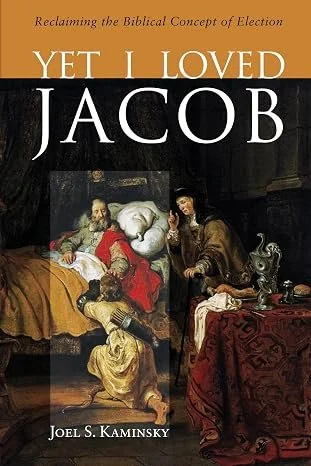
Books In Focus - Loved, Not Merely Useful Introducing Joel S. Kaminsky’s Yet I Loved Jacob: Reclaiming the Biblical Concept of Election
Ernest Nicholson
“This is a bold book, and as challenging as it is brave, and a welcome revival of interest in a core biblical theme that has been much neglected in more recent study. It is written with learning and great intelligence.”
Why Election Remains Difficult
Divine election of Israel often gets explained in terms of their vocation or usefulness. God chose Israel to bless the nations. God chose Israel to preserve the Scriptures. God chose Israel so that Jesus might come into the world. All of that may be true, but it can leave Israel sounding like a means to an end.
Israel has a task to perform. Once the task is finished, election has served its purpose.
What drew me into Joel S. Kaminsky’s Yet I Loved Jacob was the way he unsettled two common assumptions about election. Israel is not simply useful to God. Israel is loved. And those who are not elect are not necessarily opposed to God or to the elect. Kaminsky’s treatment of those two ideas gave me a better way to think about election.
Following Election through Scripture
Kaminsky begins with the family stories in Genesis: Cain and Abel, Ishmael and Isaac, Jacob and Esau, and Joseph and his brothers. These stories show that election begins in God’s mysterious preference for one person rather than another. The elected person is not always older, stronger, or more virtuous. Election comes as gift, but it also brings testing, responsibility, and sometimes suffering.
The book then widens the discussion from elected individuals to Israel’s place among the nations. Kaminsky considers promise, covenant, commandment, holiness, prophecy, and the place of outsiders. He develops three categories that organize much of his argument: the elect, the non-elect, and the anti-elect. He also traces how later Jewish and Christian writers received the biblical pattern of election.
Kaminsky builds his account of election from the biblical texts themselves. He begins with the family stories in Genesis, then widens the discussion to Israel, the nations, prophecy, covenant, and later interpretation. This movement allows the different features of election to emerge across the book rather than compressing them into a single definition.
Israel Is Loved.
What I most appreciated was Kaminsky’s refusal to reduce Israel’s election to vocation or usefulness. Christian explanations often say that Israel was chosen to bless the nations or to bring the Messiah. Paul is then interpreted as saying that Israel’s election has a past-due date. Such accounts make Israel instrumental to God’s purposes and leave Israel behind once those purposes have been fulfilled.
Kaminsky returns election to God’s love. Israel is not scaffolding that can be removed once the building is finished. God’s choosing is rooted in personal attachment. That love takes form in promise, covenant, discipline, preservation, and enduring faithfulness. Israel’s failures do not dissolve the relationship. In many biblical texts, judgment arises from it: Israel is held accountable because Israel belongs to God.
This emphasis unsettles any account of election with an expiration date. Israel was not loved only until it completed a task. God did not merely use Israel to reach the nations or produce Jesus. Israel itself remains the object of God’s love.
The Non-Elect Are Not the Anti-Elect
The other idea that stayed with me was Kaminsky’s category of the non-elect. We often imagine election as a two-part division: some are chosen and everyone else is rejected. Kaminsky shows that the biblical world is more complicated.
Ishmael is not Isaac. Esau is not Jacob. Yet Ishmael receives promises, descendants, and divine protection. Esau becomes a people and receives land and a future. They are not elect in Israel’s particular covenantal sense, but they are not therefore enemies of God.
Kaminsky reserves the category of anti-elect for those who set themselves against God and God’s people. This distinction keeps nonelection from becoming rejection. The non-elect remain within God’s blessing and purposes even though they do not share Israel’s election. God’s intense and particular love for Israel does not require the abandonment of everyone else.
A Question the Book Leaves Me Asking
Kaminsky’s argument leaves me with a difficult question: does God’s particular love for Israel mean that God loves Israel more than the non-elect? I am not sure the biblical texts allow us to measure divine love in that way. They do say that God loves Israel distinctly. God binds himself to Israel through a covenant that is not interchangeable with God’s relationship to the nations. That difference is real and should not be explained away. At the same time, the category of the non-elect keeps us from concluding that those outside Israel’s election stand outside God’s care.
Why Read It?
Yet I Loved Jacob is scholarly, but its central argument is accessible. Kaminsky works closely with biblical texts and assumes that readers are willing to stay with a difficult subject. The book will be especially useful for readers interested in Israel, covenant, the nations, Jewish-Christian relations, and supersessionism.
The book helped me see two things I do not want to lose: Israel is not merely useful to God; Israel is loved. And those who are not elect are not therefore anti-elect. Kaminsky holds those claims together without dissolving Israel’s particularity or pushing the nations outside God’s concern. That is why this book remains worth introducing to new readers.